

What Can a Fossil Teach Future Museologists?
From conservation practice to critical observation in a university collection in the Brazilian Amazon
Jéssica Tarine
04 September, 2004
Brazil, Pará
“A fossil can help students learn much more than the name of an organism. In museology education, it can become a point of entry into conservation, documentation, uncertainty, interdisciplinary work, and the responsibilities involved in caring for collections.”
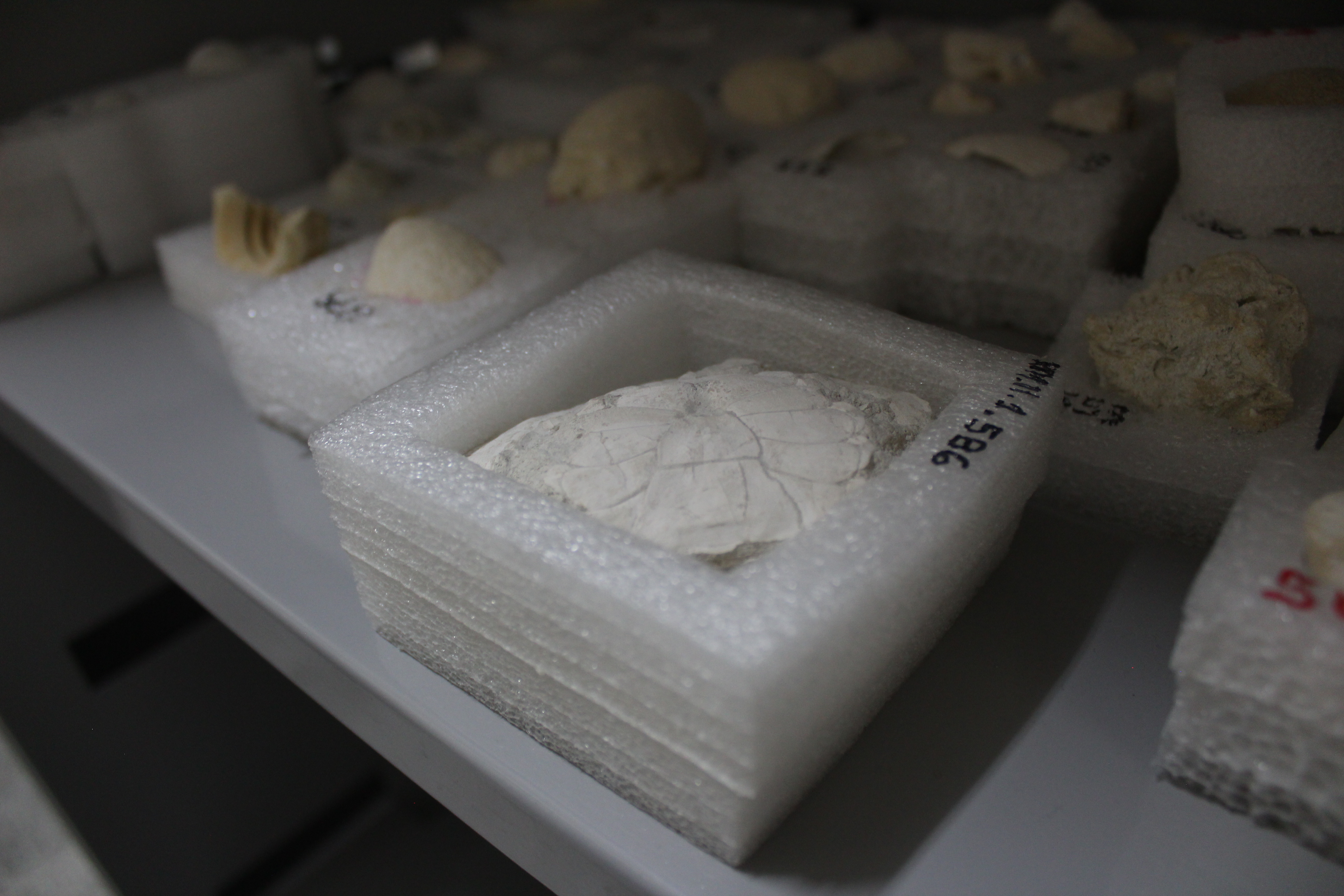
Photos of part of the Natural Heritage Collection in the Museology Course at the Federal University of Pará. 2022.
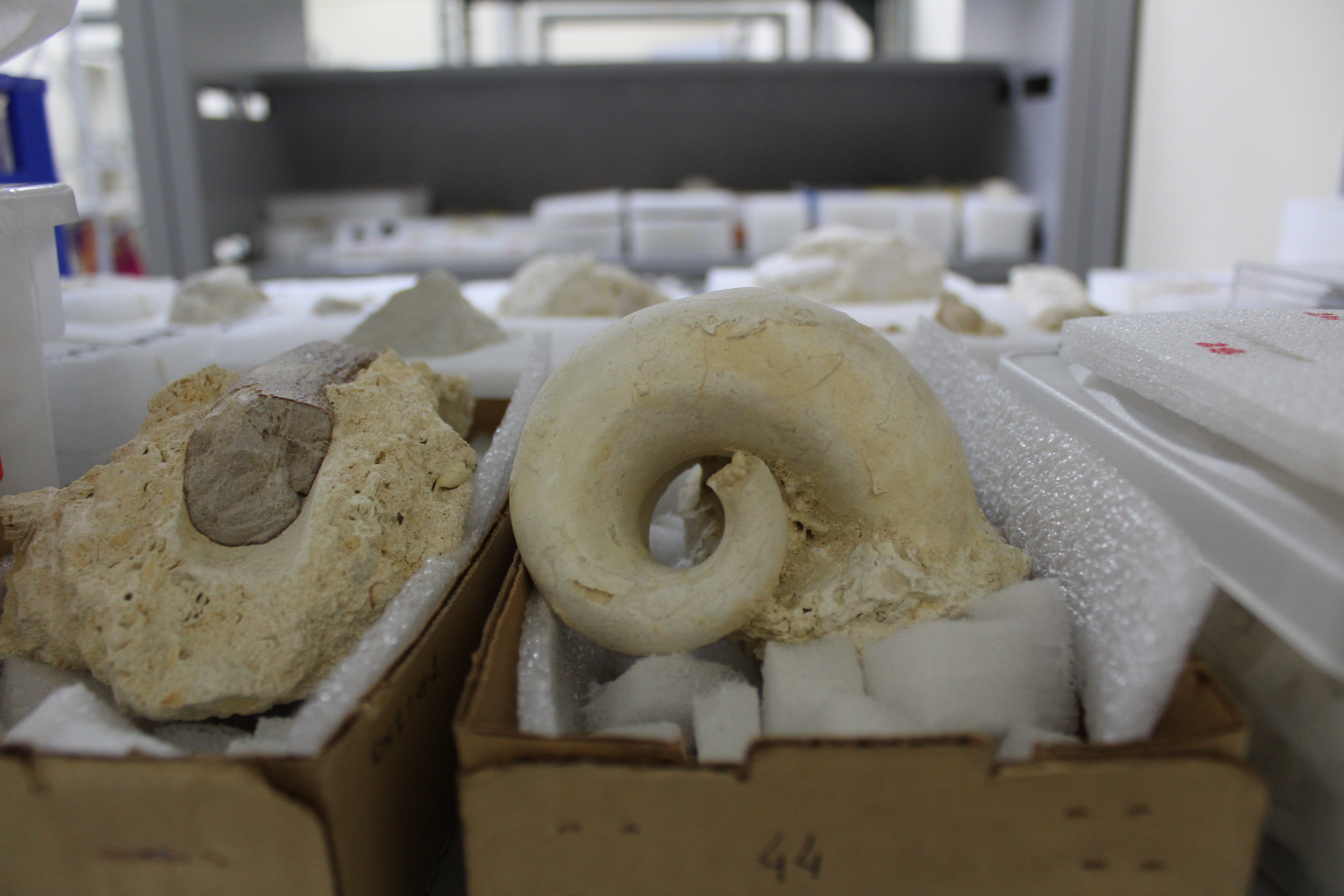
Photos of part of the Natural Heritage Collection in the Museology Course at the Federal University of Pará. 2022.
A fossil in a museology classroom
The most common question when a student is first faced with a fossil is: what is it? This question is significant, but there are many others that a future museologist should consider about it: how stable is the fossil; what happened to it after it was discovered; what does the fossil comprise and what is the rock matrix around it; can it be safely handled; what data should be registered before the treatment?
These were some of the questions that guided the fossil-related part (up to 6 hours) of the Collection Conservation Laboratory class, a 90-hour practical course that I taught to students of the fifth semester of the Museology program in the years between 2022–2024. The practical was done using fossils from the Coleção Paleontológica (CPAN) of the Federal University of Pará (UFPA) in northern Brazil. Students considered not only the scientific value of these fossils, but also as the objects of a collection that had to be managed.
UFPA possesses fossils obtained via activities from mining companies within the region. Due to the fact that numerous fossils of this type are obtained by the university, these fossils are curated using the CPAN curation team and incorporated either into research or teaching collections. In case the fossils are allocated into the teaching collection, these are available for use in Museology classes and other related teaching exercises. The aforementioned curation process allowed students to have access to the actual fossils while taking into account their nature and susceptibility (de Kluis, Romp and Land-Zandstra, 2024). The CPAN catalogue is available online at UFPA's Natural History Collections portal (https://acervosonline.ufpa.br/index.php/historia-natural).
The study of museology is taught at the undergraduate level in Brazil, and students are trained to handle the documentation, conservation, research, interpretation, and communication of the cultural and natural heritage. Museologists can work in museums, university collections, archives, cultural institutions, and community projects. It was the professional view that informed the choice of activity; the students were not meant to be palaeontologists, but learners who would know how to take care of, document, and make informed decisions regarding the fossils in the university museum collection. The direct contact with the university collections is known to enhance observation, interpretation, and recollection since students need to construct knowledge from materials as opposed to representations (Simpson & Hammond, 2012; Cobley, 2022).
The fossils in the activity were collected from the Pirabas Formation, a geological formation in northern Brazil famous for marine fossils. However, for the class, identification was not the goal of the lesson. The fossils provided an opportunity for the class to consider another question; What does it take to prepare, evaluate, document, and conserve a fossil in a university museum collection?
Building material literacy before intervention
Before practical work, students studied what fossils are and how they are formed. The importance of preserving their properties depending on the rock and mineral composition was also explained. Hardness, porosity, and such minerals as calcite, pyrite, and silica were among the issues considered. All these allowed avoiding the common error in working with fossils of thinking that all specimens react in the same way to the conditions, to the cleaning process, etc.
The deterioration was organized by the types of interacting physical, chemical, biological, and human factors. They were temperature, humidity, pressure, water, minerals or other compounds, fungi, lichens, algae, inappropriate packaging, rough handling, incorrect cleaning process, and accidents. The presentation was done not in the form of an abstract list but as factors, which can leave traces on the object. Some examples were provided illustrating that preparation and storage may be harmful to the object too. For example, there may appear mechanical traces of the tools, breakages during transportation, and deteriorations due to reactive vapours.
Therefore, in this case, the conservation began with the properties and the history of the objects. The classes emphasized the importance of stability of environment, non-reactive packaging, control of volatile substances, careful handling.
Preparation is a sequence of decisions
It may look like an obvious technique when one starts working with fossils. There is the fossil itself covered with some sediment, and a preparator removes the stuff he or she does not need to see the fossil better. But every action is interpretation. Removal of material can provide valuable information, but also delete something, damage the object or give no information about its context.
During classes, the issue of fossil preparation was considered as both the object-based learning technique and the conservation problem. Students wore protective equipment and worked with original specimens from the teaching collection to observe the influence of the matrix, the fossil and previous preparation on what they were able to do. The key point students noticed was that proper preparation required special equipment and skills. Otherwise, their attempt to see a fossil would just cause scratches, breaks or other kinds of damages. Therefore, the preparation has to be considered as the conservation technique (O'Connor et al., 2024).
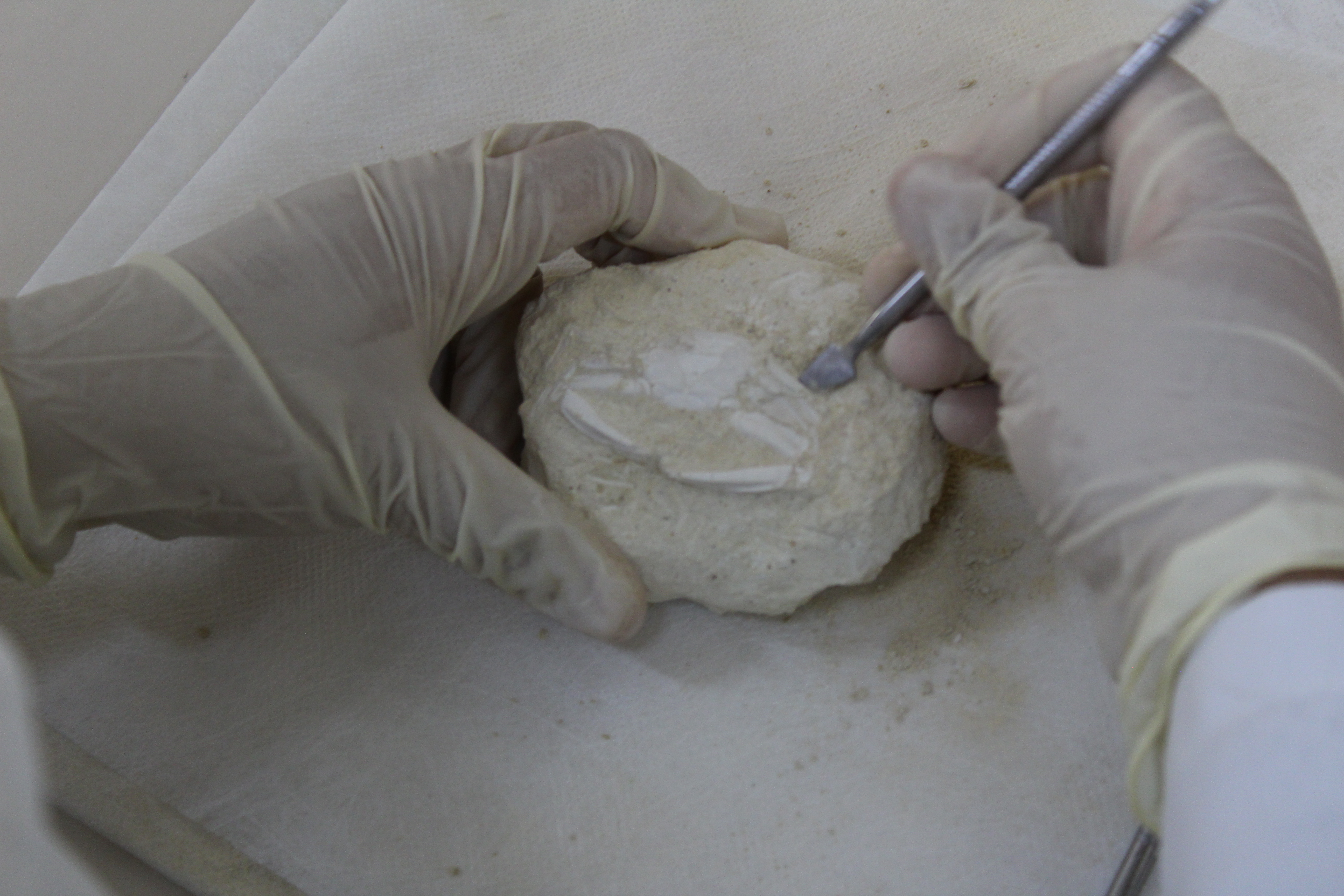
Photos of the preparation processes with students in the Natural Heritage Collection (CPAN-UFPA). 2023.
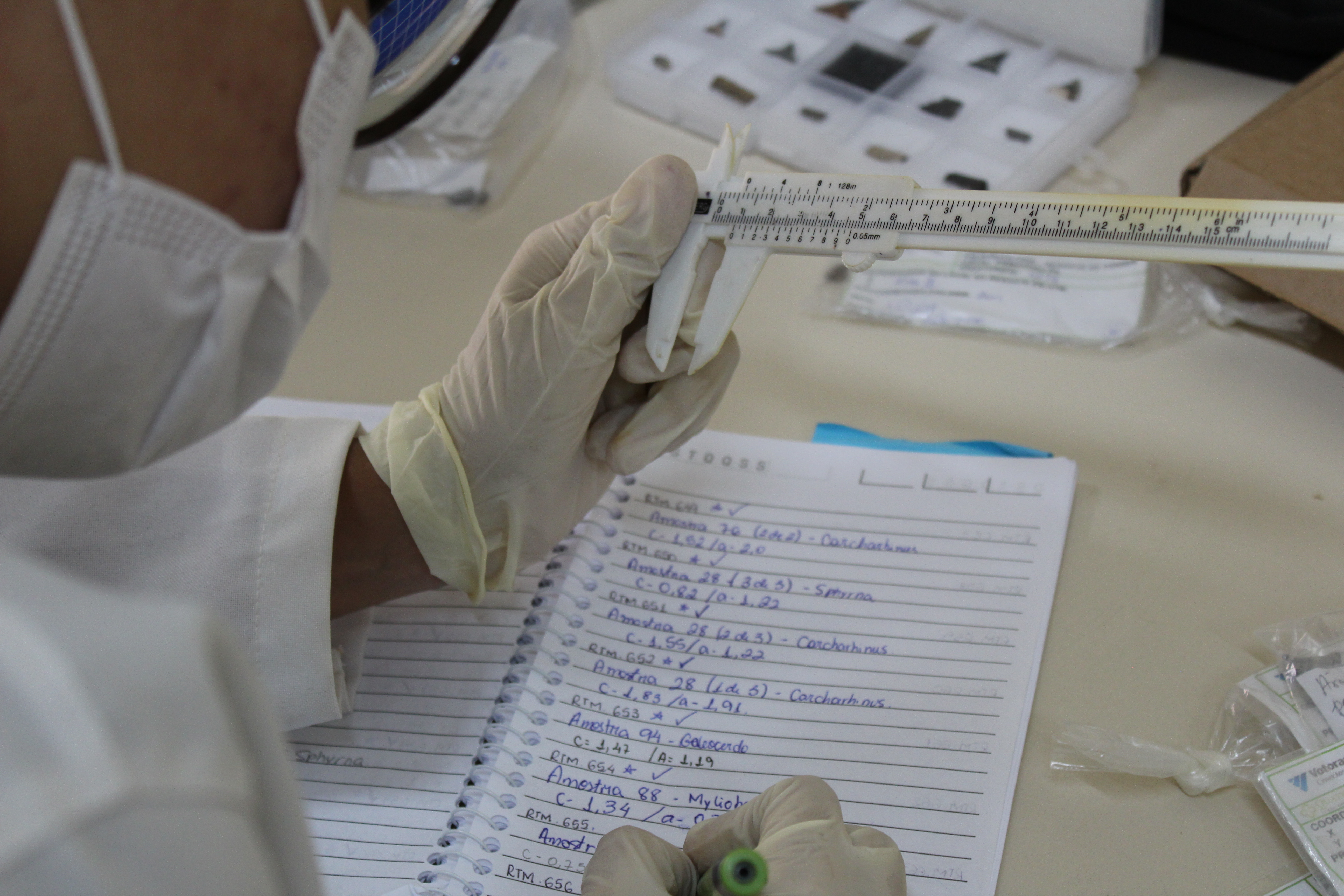
Photos of the preparation processes with students in the Natural Heritage Collection (CPAN-UFPA). 2023.
The object is not divided between 'valuable thing' and 'discarded stuff'. The matrix around it might carry geological data or add strength. Cracks, missing parts, repairs, labels, traces of past treatments are all part of the object's story. Thus preparation needs to be done with care and with the ability to differentiate between observation and assumptions.
This is the most valuable lesson that an object can teach. In a lecture, the process of conservation seems straightforward: you recognize the problem, find the solution and implement it. But when working directly with the object, uncertainties arise. Various factors can co-exist, suggested solutions can have conflicting effects and the best course of action could be to defer treatment until further data are available.
The technical report as a way of learning to see
The fossils were additionally linked with an exercise on creating technical conservation reports. Students were supposed to be able to translate their visual observations into language that would be precise and accountable. That meant not only describing the damage but also analyzing what they saw, distinguishing between material and change, considering different reasons, and justifying their terminologies with suitable references.
Creating a condition report alters how the object is observed. A phrase like "fossil is fragile" is not precise enough. What is the source of the fragility? Is there any cracking, powdering, detachment, loss, instability, or some other signs? Can we say that the condition concerns the fossil, the matrix, the adhesive, the label, the packaging, or something else? What are the suitable descriptions for what can be seen without exaggeration?
One of the types of assignments that were given in all three classes was a concise illustrated technical report that included condition assessment, risks, and a recommended course of actions. This task meant translating the close observation into professional analysis by distinguishing between what students could see and what they might guess, explaining the importance of the matter, and proposing suitable steps.
This report also illustrates the limitations of individual expertise. The museologist can record condition, history of handling, storage requirements, and conservation hazards; however, some questions demand discussion between the museologist and palaeontologists, geologists, conservators, collection managers, or lab technicians. Acknowledging the need for another type of knowledge is not a limitation but a skill of a professional.
For the students, this project connected documentation and conservation. The technical documentation was not treated as a piece of paper that appears as an outcome of practical work, but became the intervention itself, helping to slow down attention, make decisions transparent, facilitate further monitoring, and provide information for another professional about what was recorded and decided.
What the fossil teaches
To observe before naming. Identification can guide care, but an unfamiliar specimen still offers material evidence. Students can begin by describing form, texture, colour, weight, fractures, residues, supports, labels, and previous interventions.
To separate evidence from interpretation. A condition report should make clear what is visible, what is inferred, and what remains unknown. This distinction protects both the object and the credibility of the record.
To accept uncertainty. Museum work rarely begins with complete information. Learning to register a doubt, suspend a decision, or request specialist advice is part of responsible practice.
To connect actions. Preparation, documentation, storage, handling, research, and communication are not isolated stages. A choice made in one area affects all the others.
To understand care as responsibility. Conservation is not a search for visual perfection. It is an effort to preserve evidence, reduce risk, and maintain the specimen's capacity to support research, teaching, and public engagement.
A classroom activity that can be adapted
This learning experience can also be tailored to fossils, geological objects, biological samples, archaeological material, and others which require specialized knowledge for preservation. It consists of a finished sequence of instruction along with a structure that other teachers can adapt. This can be done in five steps.
1. Establish material literacy. Introduce fossilisation processes, rock properties, common mineral compositions, and the relationship between a fossil and its matrix. Ask students to predict why different specimens may require distinct forms of care.
2. Construct a comparative vocabulary. Students record only what they can support through observation, including fractures, loose particles, residues, exposed areas and signs of previous preparation. They separate description from interpretation and note uncertainty explicitly.
3. Inspect before acting. Wearing full PPE, students work directly with original fossils selected for the teaching collection, or with detailed images when handling is restricted. They consider which tools, levels of magnification and degrees of intervention are appropriate, and when the safest decision is to stop and seek further expertise.
4. Discuss preparation and care. Present the available procedures, such as cleaning, preparation, stabilisation, or rehousing, according to the course context. Each group should describe the expected benefit, possible harm, and evidence supporting its choice. 'No intervention yet' must remain an acceptable conclusion.
5. Produce and compare technical records. Students organise their observations into a condition or conservation report, separating description, diagnosis, risk, recommendation, and matters requiring specialist consultation. Groups then compare wording and discuss unsupported claims, ambiguous terminology, and missing information.
Questions for reflection
What did you notice before you knew what the object was?
Which observations could be verified, and which were interpretations?
What information was missing from the specimen and its documentation?
Could preparation reveal one form of evidence while destroying another?
Who should participate in deciding what happens to the object?
How would your report support someone examining the specimen five or ten years from now?
From scientific specimen to university heritage
The fossil held in a university collection has more than one temporality. This includes both its own past history, as well as that of collecting, studying, teaching, curating, and past conservation decisions. Working with it means participating in an ongoing biography of the object.
This way of looking at the fossil is especially pertinent to museology studies. Future professionals are not expected to become palaeontologists to handle fossils properly, but they should know how their disciplines intersect when dealing with the object. They should also be aware that university collections are not passive storage spaces. They are active learning spaces where future professionals can apply what they've learned before handling the same decisions in a museum or laboratory setting.
This sequence explained why learning from objects is particularly important for conservation. Lectures provided vocabulary for the students, while the handling of fossils proved if the language used by students was precise enough. This specimen does not allow for easy conclusions. Its physical condition disrupts generalization and makes the students re-think, select their words, consider alternatives, and set boundaries. Such skills are not secondary; they are essential to the work of a museum.
What lessons can a fossil give future museologists? Observing, documenting, acting responsibly, collaborating between disciplines, and understanding the meaning of care, these are only some of the lessons that can be learned. Possibly, one of the most crucial lessons is that the interaction with collections is not about having all the answers at hand from the beginning, but about asking better questions.
References
Cobley, J. (2022). Why objects matter in higher education. College & Research Libraries, 83(1), 75–98. https://doi.org/10.5860/crl.83.1.75
de Kluis, T., Romp, S. and Land-Zandstra, A. M. (2024). Science museum educators' views on object-based learning: The perceived importance of authenticity and touch. Public Understanding of Science, 33(3), 325–342. https://doi.org/10.1177/09636625231202617
O'Connor, C. J., Burr, E., Cooper, C. and Meyer, H. W. (2024). Updating conservation techniques for paleontology collections associated with Florissant Fossil Beds National Monument. Parks Stewardship Forum, 40(1), 217–241. https://doi.org/10.5070/P540162932
Simpson, A. and Hammond, G. (2012). University collections and object-based pedagogies. University Museums and Collections Journal, 5, 75–82. https://doi.org/10.18452/8724
Jéssica Tarine
Brazil
PhD in Science from the Federal University of Rio de Janeiro (UFRJ), a Master’s degree in the Preservation of Scientific Collections from the Museum of Astronomy and Related Sciences (MAST), and a degree in Museology from the Federal University of the State of Rio de Janeiro (UNIRIO). She teaches in the Museology undergraduate programme, the Graduate Programme in Heritage Sciences (PPGPatri-UFPA), and the Graduate Programme in Information Science (PPGCI-UFPA) at the Federal University of Pará (UFPA), where she also serves as Deputy Coordinator for the 2026–2027 term. She coordinates UFPA’s Collections and Museums Network Extension Programme and is a member of the Laboratory for Collection Storage Practices (LAPRET). Her teaching, research, and outreach activities focus on museology, cultural heritage, documentation, and collections management.