
From object-based learning to collection-based learning in architecture
Architectural collections as project sites
Sezin Sarıca
15 May, 2026
Turkey, Ankara
This text introduces an early-stage postdoctoral research question developed by the author. It reflects on how object-based learning might be extended toward a collection-based approach in architectural education.
Architectural education often works through drawings, models, fragments, and – of course – collections. Yet object-based learning has rarely been discussed in relation to the specific needs of architectural design pedagogy. This text proposes “collection-based learning” as a way to rethink architectural collections not only as repositories of historical material, but also as active project sites where students can read, compare, classify, and transform objects into architectural design knowledge.
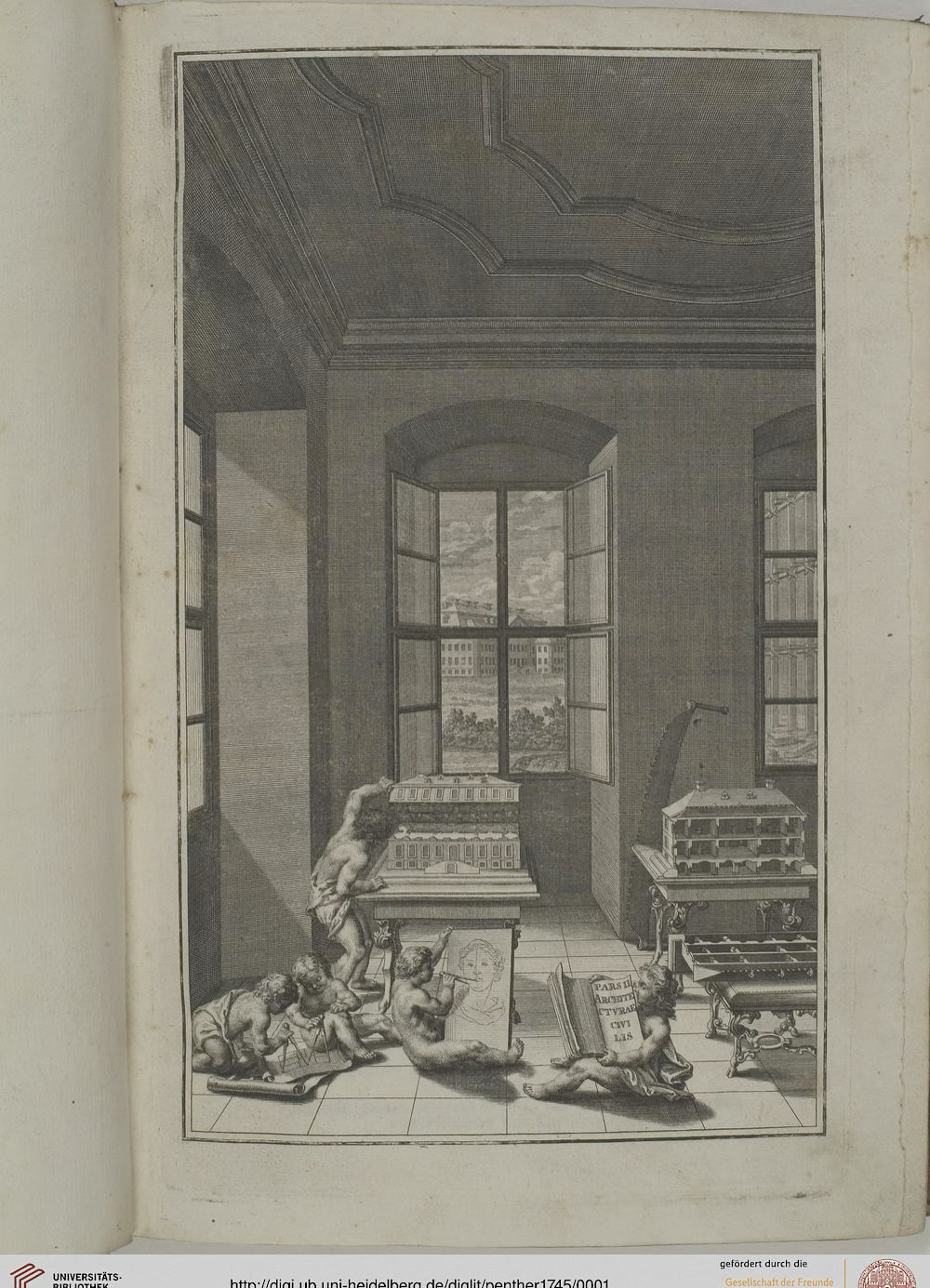
Figure 1. Frontispiece. Source: Johann Friedrich Penther, Ausführliche Anleitung zur bürgerlichen Bau-Kunst (Band 2): Worin durch zwantzig Beyspiele gewiesen, wie die Erfindungen von allerhand Wohn-Gebäuden aus Stein und Holtz ... zu machen .. Augspurg, 1745. Heidelberg Digital Library. https://doi.org/10.11588/diglit.1659#0001
Teaching collections: from university collections to architectural pedagogy
Recent research into the university collections emphasizes their pedagogical role in object-based learning environments (Simpson & Hammond, 2012; Whitmer & Hünniger, 2024; Kador, 2025). These studies show that these collections have historically served not just as repositories of exemplars but also as spaces for speculative thinking and experimentation. Often called “object lessons,” students interacted directly with artifacts and interpreted them as part of their learning. This indicates that collections are not only archives of knowledge but also active pedagogical infrastructures that encourage interpretive and creative thinking.
While this field of research is predominantly grounded in educational theory and especially scientific education, and has been instrumental in articulating the concept of “object-based learning” (OBL),their implications for current architectural knowledge production remain underexplored. One significant project in architectural research that examines objects in relation to architectural knowledge is the Coded Objects project, led by architectural theorist Prof. Dr. Anna-Maria Meister. In her article “Coded Objects: A Material Method,” Meister examines how objects can be understood as methodological tools that organize knowledge (Meister, 2024). As Meister defines them, “coded objects” are understood as “methods, not categories,” aiming to “carve out discourses of responsibilities, aspirations, and techniques of forming values…” (Meister, 2024). This approach is particularly important for this discussion, as it allows architectural objects and collections to be understood not only as materials to be preserved or studied, but also as methodological instruments within knowledge production.
Within this broader framework, the history of university collections can also be reconsidered in relation to architectural design pedagogy. Historically, “teaching collections” in architecture schools were not merely repositories for objects, they were also spaces where drawing and design instruction took place. As institutional predecessors of architectural and art museums, these collections were established with explicit pedagogical intentions, encouraging learning through copying, comparison, and combination. This is evident in the history of Central European applied arts museums. In The Design Prototype as Artistic Boundary: The Debate on History and Industry in Central European Applied Arts Museums, 1860-1900, architectural historian Mitchell Schwarzer discusses how these museums were founded with aims that are “almost exclusively didactic,” oriented toward the “reawakening and elevation of the applied arts through the gathering together of valuable models,” so that improvement could be achieved through the “visual inspection, use, and study of outstanding or instructive works” (Schwarzer, 1992). In this sense, acts such as curating recall the historical role of teaching collections, in which gathering, copying, classifying, and comparing objects formed the basis of pedagogical and design-oriented inquiry.
From object to collection in architectural learning
Building on these discussions, this text shifts focus to architectural knowledge and questions whether a collection-based pedagogical approach in architectural learning can incorporate object-based learning methods and expand their application beyond the current scope.
While OBL foregrounds the individual object as the unit of encounter, a collection-based model can propose that both the object itself and the relations between objects can become pedagogical instruments. In other words, the object remains important, but it is no longer isolated from the collection's spatial properties. Albena Yaneva’s reading of the Canadian Center for Architecture offers a useful example here. In Crafting History: Archiving and the Quest for Architectural Legacy, she notes that when objects from different architectural practices are placed synoptically on the same shelf, for instance, “Rossi, next to Stirling, next to Eisenman”, their individual power is “intensified as they share space together,” with each work being “amplified, empowered, by the other” (Yaneva, 2020). In this sense, the space of the collection itself becomes part of the learning process (Figure 2-3).
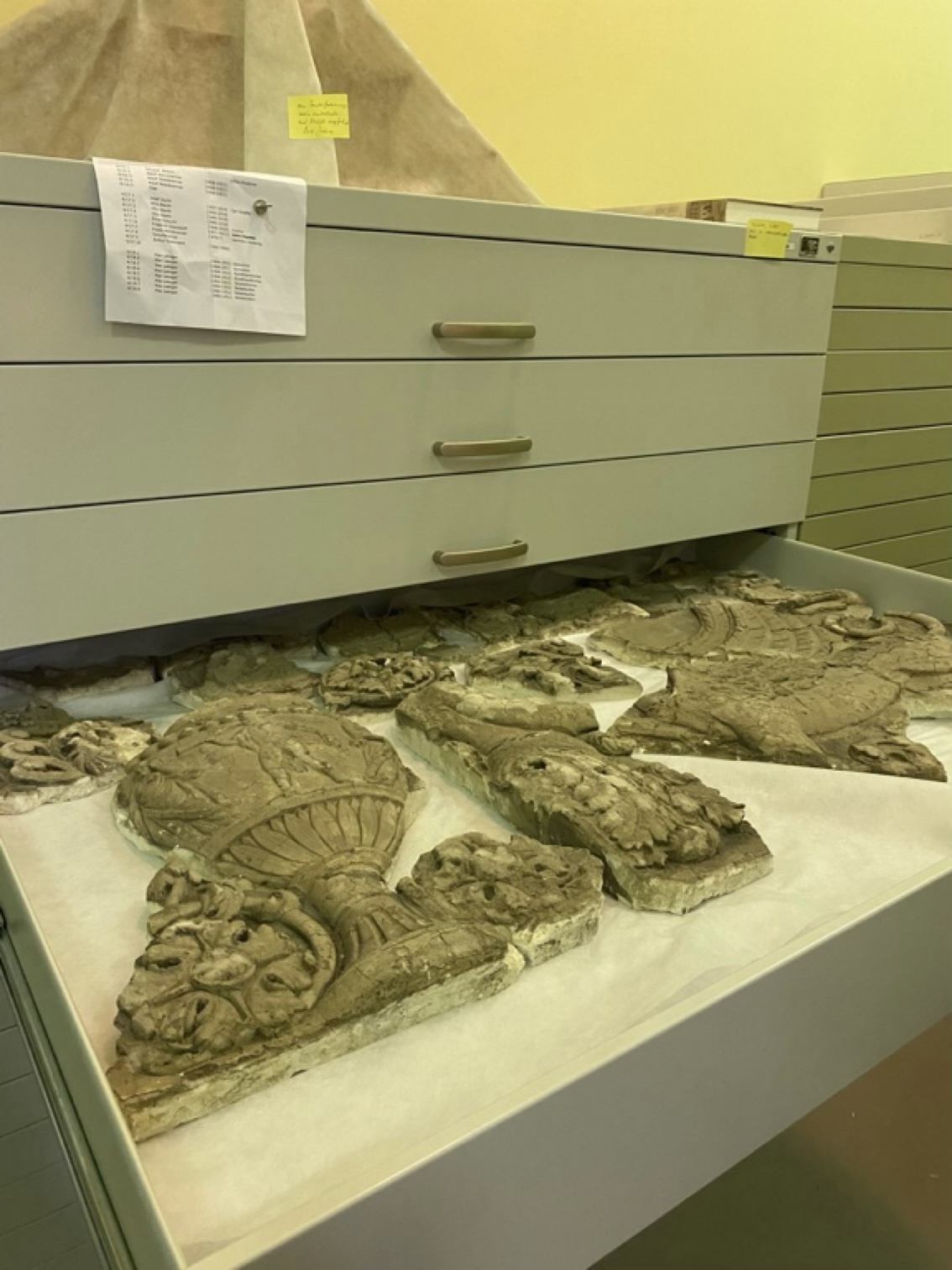
Figure 2. Stadt Münze reliefs, saai | Archive for Architecture and Engineering, KIT Karlsruhe. Photograph by Sezin Sarıca, taken during archive visit, 2024. Courtesy of saai/KIT.
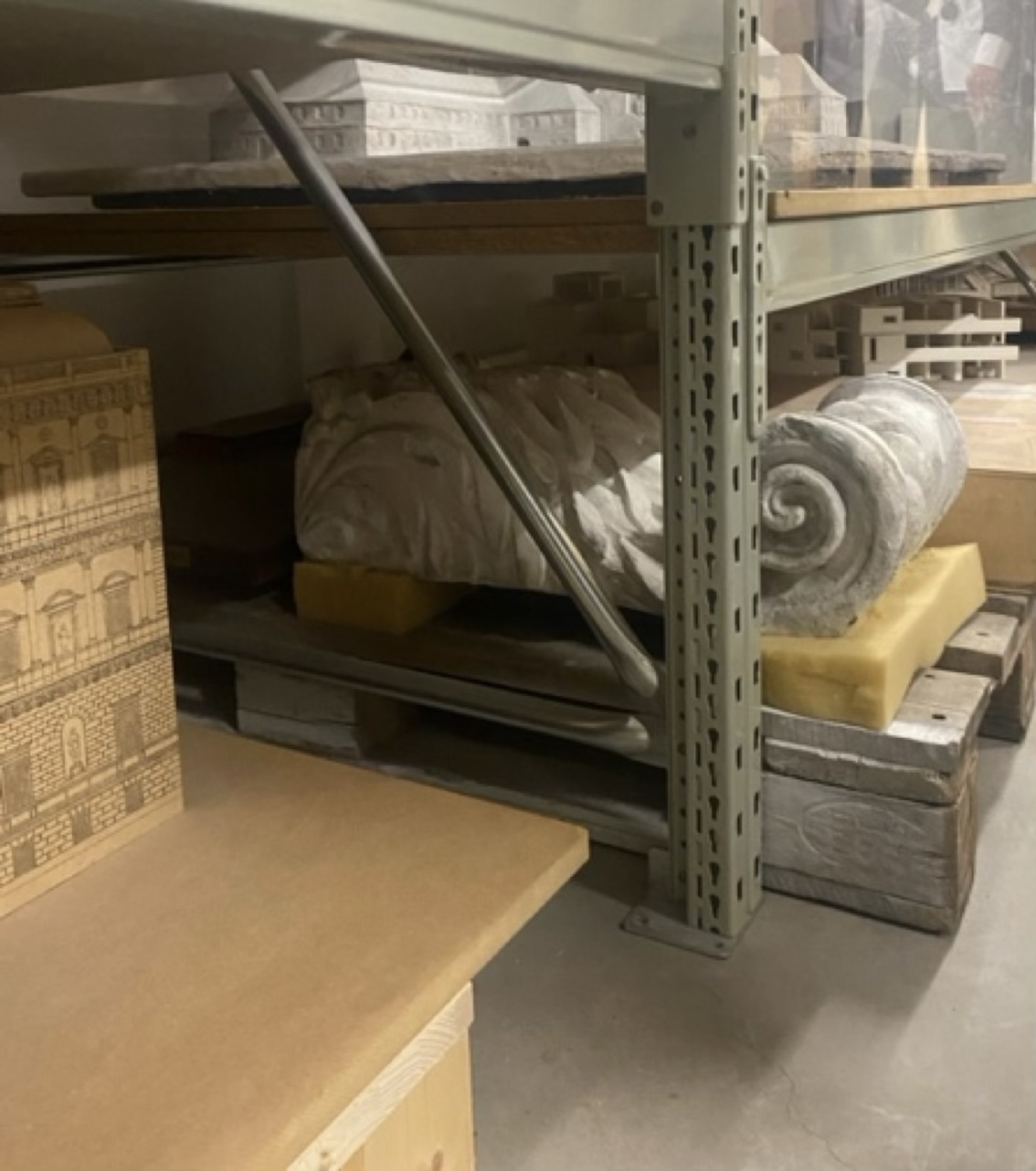
Figure 3. Archival model fragments, Architekturmuseum der TUM. Archive spaces at Architekturmuseum TU Munich, Munich. The model room features fragments: an ornament cast attributed to Brunelleschi and a detail model of the Pompidou Center, placed side by side on the same rack. Photograph by Sezin Sarıca, taken during archive visit, 2024. Courtesy of Architekturmuseum der TUM.
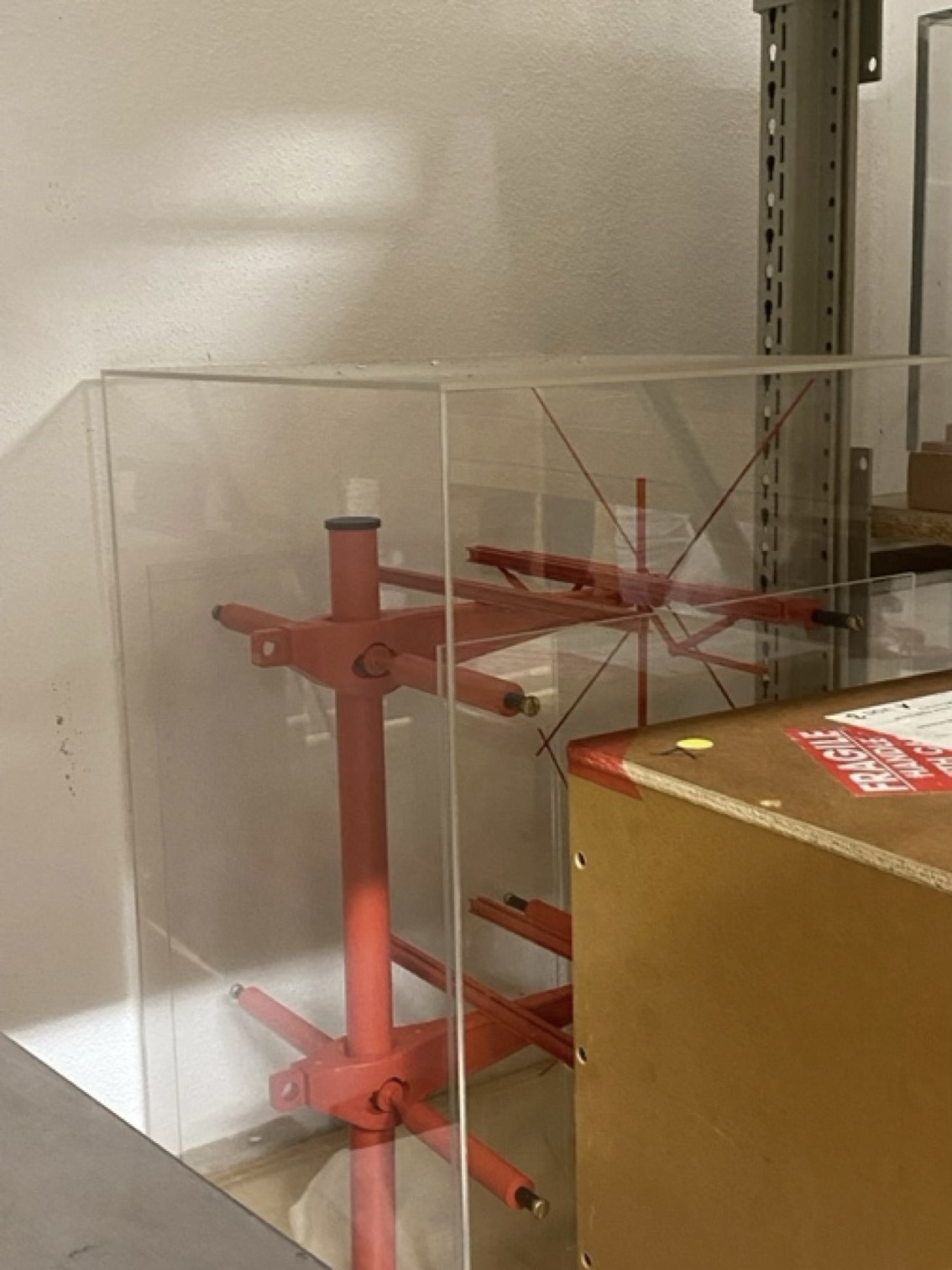
Although Thomas Kador discusses the “power of place” in his book Object-Based Learning: Exploring Museums and Collections in Education, emphasizing the positive effect of the collection space on perception and learning, this spatial dimension can be expanded further within an architectural framework (Kador, 2025). For architecture students, the collection space not only provides comfort or supports a better perception of the object; it can also become an interpretive input in itself. The distinction between studying an individual object and studying a certain collection of objects is therefore not merely semantic. It can change what students do: they re-relate rather than just observe. It also changes what kind of knowledge is generated: design grammars rather than individual object literacy. But a collection-based approach in architecture does not replace object-based learning; rather, it begins with the close study of particular objects as well and can then reposition them within broader relational fields. In this process, particular attention can be given not only to finalized design products, but also to working drawings, sketches, study models, notebooks, and archived student works. Through these materials, learners engage with architectural collections, both physical and digital, by practicing selection, classification, comparison, copying, and recombination.
As a result, learners may first understand particular objects through object-based learning and then re-understand them in relation to other objects within the (physical or digital) space of the collection. This process can enable students to construct new classifications, identify similarities and differences, and develop design grammars. Collections and archived student projects may thus transform from static repositories into modes of making that mediate between historical-theoretical knowledge and speculative imagination, which is itself an architectural design process.
Architectural collections as project sites
From this perspective, architectural collections can be repositioned as active epistemic “project sites” within architectural design. In architectural studios, each project usually starts with a site, a geographical context through which students make observations, develop interpretations, and craft design responses. This familiar studio framework can also be applied to collections: an architectural collection can serve as a site for reading, mapping, comparing, and transforming. Achieving this involves reclaiming both the space and content of university architectural collections to foster design thinking.
In academic discourse, architectural archives, institutionalization, and collecting have been widely discussed, particularly in the wake of the archival turn (Yaneva, 2020). However, in terms of spatial access and direct interaction, architectural collections often remain difficult to observe and engage with in design thinking, since the artifacts they contain are treated primarily as materials to be preserved. However, even when digitized, they are frequently confined to archival territories and function mainly as research tools for dedicated historians.
Yet, as noted under the first title, their roles in architectural theory and design practice have historically been far more integrated than commonly assumed. Architectural collections have supported practices of drawing, copying, classifying, comparing, and recombining. For this reason, treating architectural collections as project sites does not mean neglecting their archival or historical value. Rather, it expands their role in architectural education: from repositories of completed works to active “project sites” where design questions, relational readings, and speculative methods can emerge.
A perspective from Turkey
There is also a context-specific need for this discussion in Turkey, where most university-based architectural collections are not yet institutionalized as active pedagogical infrastructures and remain largely disconnected from design education. Although several universities have developed archives, student-work repositories, and digital collections such as the METU Faculty of Architecture’s DOME, the initiated digitalization project of METU Architectural Design Studios journals collecting the student projects for many years, ITU Faculty of Architecture’s student project archives, and MSGSÜ’s digital archive, these initiatives are often oriented toward preservation or access to documents, rather than being systematically integrated into studio pedagogy. In this sense, the issue is not the absence of architectural collections but the limited pedagogical activation of these materials within design education.
There are, of course, important collections and research institutions in Turkey, such as SALT and VEKAM, which support valuable research on architectural history, urban culture, and visual-material archives. However, these collections are generally engaged through historical or graduate-level research rather than being directly integrated into design pedagogy as active project environments.
Thus, a collection-based pedagogical model may enrich drawing and model collections, support diverse modes of making, and transform archived student work into dynamic reference environments. In this sense, we can say that architectural collections, whether institutionalized or still emerging, might become active environments for studio learning, interpretation, and making.
Closing questions
The questions raised in this text are planned to be further developed through the author’s planned postdoctoral research. Rather than offering a completed model, this early-stage inquiry provides a framework for thinking about the pedagogical potential of architectural collections. The closing question (hopefully to be answered) can be:
How can architectural collections function as “project sites” within architectural design pedagogy, particularly through engagement with process-based artifacts such as working drawings, sketches, notebooks, study models, and archived student works?
What is the difference between object-based learning and collection-based design pedagogy, and what specific forms of knowledge do they generate in architectural learning and making processes?
References
Kador, T. (2025). Object-based learning: Exploring museums and collections in education. Routledge.
Meister, A.-M. (2024). Coded objects: A material method. Technology | Architecture + Design, 8(2), 183–186.
Schwarzer, M. (1992). The design prototype as artistic boundary: The debate on history and industry in Central European applied arts museums, 1860–1900. Design Issues, 9(1), 30–44.
Simpson, A., & Hammond, G. (2012). University collections and object-based pedagogies. In Proceedings of the 11th Conference of the International Committee of ICOM for University Museums and Collections (UMAC), Lisbon, Portugal, 21–25 September 2011 (pp. 75–82). International Committee for UMAC.
Whitmer, K. J., & Hünniger, D. (2024). Collections and pedagogies of objects in European learning environments: Introduction. Nuncius, 39(3), 567–587.
Yaneva, A. (2020). Crafting history: Archiving and the quest for architectural legacy. Cornell University Press.

Sezin Sarıca
Turkey
Sezin Sarıca, Ph.D. graduated from the METU Faculty of Architecture, and received her M.Arch and Ph.D. degrees from METU, where she is currently a Dr. Research Assistant. She is a member of the EAHN research group “Building Word Image.” Within the Getty Foundation – Keeping It Modern project, she worked on the curatorial team of the Archive Exhibitions displayed at METU and TU Delft. She has co-coordinated drawing and design workshops, participated in international conferences, and published in JoLA, Architectural Histories Journal, and a variety of (inter)national architectural platforms. Her research focuses on art–architecture relations, nineteenth-century German architectural theory, methodologies of making, object-based learning, collection-based pedagogies, and the concept of Bildung.